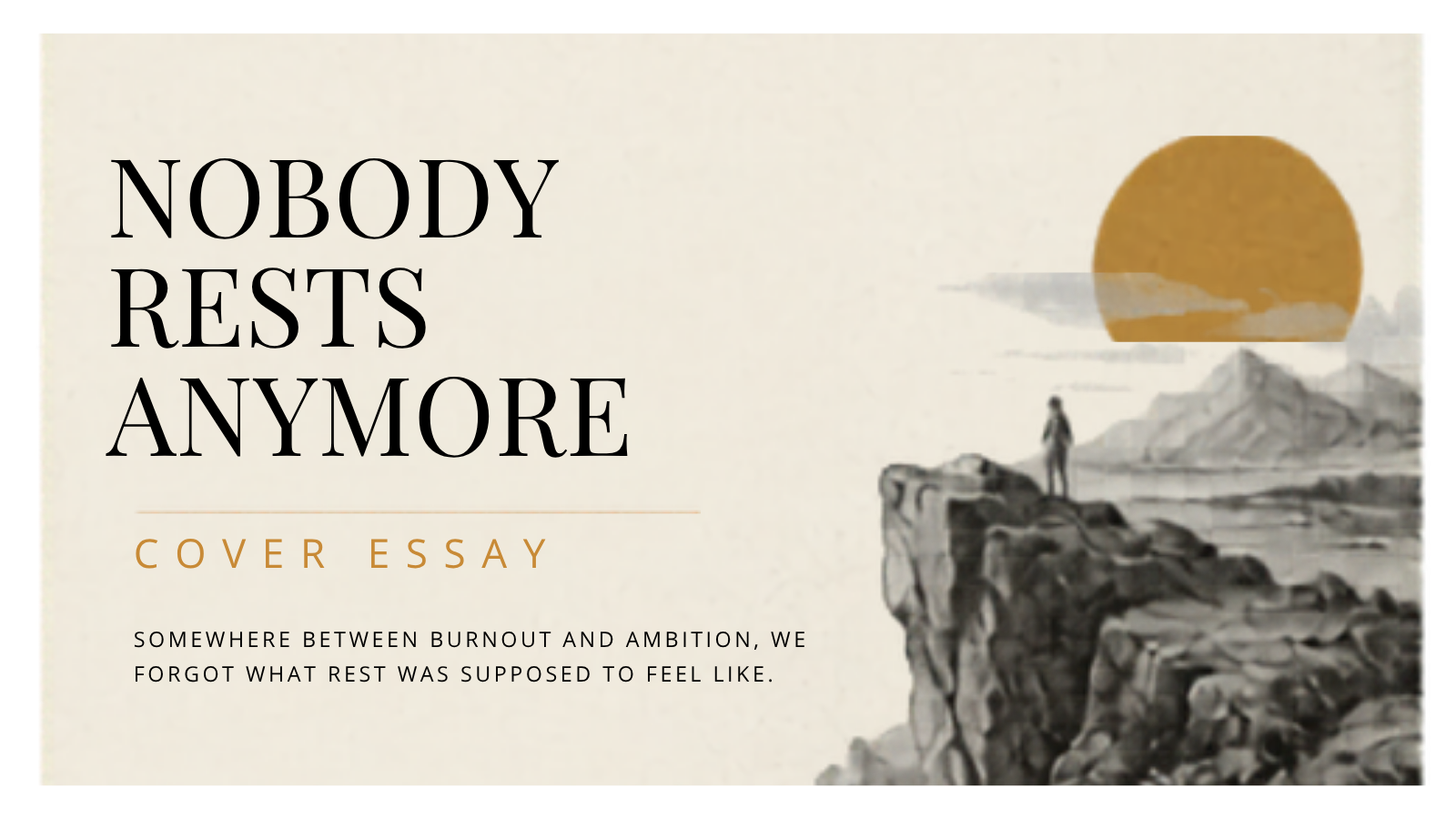
Nobody Rests Anymore
There was a time when rest was naturally woven into human life.
People worked hard, but there were pauses built into existence:
quiet mornings,
long dinners,
weekends without notifications,
evenings without blue light glowing across exhausted faces.
Boredom existed.
Silence existed.
Waiting existed.
Now almost none of it survives.
Modern life has become a nonstop performance of productivity, availability, and stimulation. People wake up already mentally behind. Before their feet even touch the floor, their brains are flooded with emails, headlines, messages, videos, advertisements, opinions, tragedies, and reminders that they are somehow still not doing enough.
Nobody rests anymore because the modern world no longer rewards rest.
It rewards output.
It rewards speed.
It rewards visibility.
And over time, entire societies began confusing exhaustion with purpose.
The result is a civilization permanently running on emotional fumes.
The average person today is overstimulated before breakfast.
Phones have turned every moment into an opportunity for consumption. There is no natural stopping point anymore. Social media platforms are engineered to eliminate pause entirely. Endless scrolling means there is always one more video, one more argument, one more trend, one more reason to stay mentally plugged in.
Human beings were never designed for infinite input.
The nervous system evolved to handle temporary danger:
a storm,
a predator,
a moment of crisis.
Instead, modern brains now process hundreds of micro-stressors every single day.
Unread texts feel urgent.
Notifications feel demanding.
Algorithms create emotional whiplash:
comedy followed by war footage,
celebrity gossip followed by tragedy,
motivation followed by insecurity.
The brain never fully settles.
Even moments that appear restful are often just different forms of stimulation.
People lie in bed “relaxing” while simultaneously absorbing enough information to emotionally overwhelm the nervous system ten times over.
That is not rest.
That is consumption disguised as recovery.
The tragedy is that many people no longer even remember what true rest feels like.
Real rest is not simply sleep.
Real rest is emotional unclenching.
It is safety.
It is silence without guilt.
It is existing without feeling pressured to optimize every moment of your life.
But modern culture turned rest into something people must “earn.”
People apologize for taking breaks.
They feel guilty for slowing down.
Even vacations are documented like marketing campaigns.
Somewhere along the way, human beings stopped living and started managing themselves like exhausted corporations.
Every hobby became monetized.
Every interest became content.
Every thought became branding.
Even self-care became performance.
The language of wellness itself became exhausting:
heal,
optimize,
transform,
grind,
manifest,
improve,
hustle.
People are now expected to constantly evolve while simultaneously surviving economically, emotionally, socially, and psychologically in an increasingly unstable world.
No wonder everyone feels tired.
Burnout used to describe extreme workplace stress.
Now burnout describes everyday existence.
Parents are burned out.
Students are burned out.
Teenagers are burned out.
Healthcare workers are burned out.
Teachers are burned out.
Creators are burned out.
Even children are emotionally exhausted.
People are not just physically tired anymore.
They are mentally fragmented.
Modern exhaustion is deeper than lack of sleep because it is rooted in chronic emotional overstimulation. The brain rarely gets a chance to process anything before the next crisis arrives.
One headline replaces another.
One trend replaces another.
One outrage replaces another.
Human beings are carrying enormous emotional weight without any real opportunity to recover from it.
Social media intensified this collapse dramatically.
For the first time in history, ordinary people became exposed to the emotional realities of millions of strangers simultaneously. People now witness constant suffering from around the world in real time while also being expected to continue functioning normally at work, school, and home.
The nervous system struggles to differentiate between immediate danger and digital exposure to danger.
As a result, many people live in low-grade fight-or-flight constantly.
Their bodies never fully power down.
Their minds never fully quiet.
And eventually, exhaustion becomes identity.
There is also an invisible loneliness beneath modern exhaustion.
People are more digitally connected than ever while feeling increasingly emotionally disconnected from one another.
Conversations became shorter.
Attention spans became fractured.
Moments became interrupted by screens.
Even friendships now compete with algorithms.
People sit beside each other while mentally existing somewhere else entirely.
Many individuals no longer experience uninterrupted presence from others. Genuine listening became rare. Emotional intimacy became harder to maintain in cultures built around distraction.
Rest requires emotional safety.
But emotional safety becomes difficult when attention itself feels unstable.
This is why so many people feel emotionally starved despite constant interaction.
The human brain does not interpret endless online exposure as meaningful connection.
It interprets it as noise.
Capitalism also plays a major role in the death of rest.
Modern economies thrive on human attention. Rested people consume less. Stillness does not generate profit. Silence cannot be monetized easily.
So entire industries compete to keep people stimulated indefinitely.
Streaming platforms autoplay the next episode automatically.
Apps send notifications designed to trigger dopamine responses.
Social media rewards emotional reactivity because outrage generates engagement.
The modern attention economy survives by keeping human beings psychologically activated.
The more distracted people become, the more profitable they are.
Rest becomes almost rebellious in environments designed to prevent it.
Choosing stillness now requires intentional resistance against systems engineered to consume attention at all times.
There is also enormous social pressure attached to productivity culture.
People feel compelled to constantly prove they are working hard enough, successful enough, ambitious enough, healing enough, improving enough.
Rest became associated with failure.
Meanwhile exhaustion became romanticized.
People brag about lack of sleep.
Overworking became identity.
“Busy” became social status.
But exhaustion is not proof of worth.
Constant stress is not evidence of importance.
Human value cannot survive forever attached to productivity alone.
At some point, societies must confront a difficult truth:
a civilization that cannot rest eventually breaks itself.
And in many ways, that fracture is already happening.
Rising anxiety.
Chronic depression.
Emotional numbness.
Attention disorders.
Sleep disturbances.
Nervous system dysregulation.
Addiction.
Isolation.
Many modern mental health struggles are not individual failures.
They are environmental responses.
People are adapting psychologically to conditions human beings were never biologically designed to endure continuously.
Children may ultimately reveal the deepest consequences of this exhausted culture.
Many kids now grow up in environments where attention is fragmented from birth. Tablets replace boredom. Constant stimulation replaces imagination. Quiet moments disappear before they fully develop.
Young nervous systems are learning dependency on high-speed stimulation before emotional regulation skills fully form.
At the same time, parents themselves are exhausted beyond capacity.
Many families are surviving rather than living.
And survival mode changes people.
It shortens patience.
It increases irritability.
It reduces emotional bandwidth.
The modern family often exists under enormous invisible pressure:
economic instability,
digital overload,
social isolation,
burnout,
fear about the future.
Rest becomes difficult when survival itself feels uncertain.
Yet despite all of this, human beings still crave rest deeply.
You can see it everywhere.
The popularity of slow living.
The longing for nature.
The obsession with “disconnecting.”
The desire to escape cities, algorithms, noise, and pressure.
People are not weak for wanting peace.
Their nervous systems are begging for recovery.
What many individuals call laziness is often untreated exhaustion.
What many call unmotivated is sometimes emotional depletion.
What many call burnout may actually be the human body protesting impossible conditions.
The body eventually forces pauses the mind refuses to take willingly.
Anxiety attacks.
Depression.
Emotional shutdown.
Chronic fatigue.
Numbness.
These are not always personal defects.
Sometimes they are survival responses.
Nobody rests anymore because the modern world forgot that human beings are not machines.
Machines can run continuously until they break.
Humans break emotionally first.
And emotional collapse rarely happens dramatically all at once. More often, it arrives quietly:
difficulty concentrating,
constant irritability,
feeling detached,
feeling numb,
feeling overwhelmed by small things,
losing excitement for life itself.
Many people are not living fully anymore.
They are merely functioning.
Completing tasks.
Paying bills.
Answering notifications.
Surviving schedules.
But survival is not the same thing as peace.
And productivity is not the same thing as fulfillment.
Perhaps the future will eventually force society to rediscover something previous generations understood instinctively:
Rest is not laziness.
Rest is maintenance for the human soul.
Silence is necessary.
Stillness is necessary.
Slowness is necessary.
Without them, people slowly lose connection to themselves.
Maybe healing begins when people stop treating rest like something to apologize for.
Maybe the most radical thing a person can do in an exhausted society is simply pause.
Not to perform wellness.
Not to optimize productivity.
Not to create content about healing.
Just to breathe.
Just to exist quietly for a moment without needing to prove anything at all.
Because somewhere beneath the noise, beneath the pressure, beneath the endless stimulation, the human mind is still searching for the one thing modern life keeps taking away:
peace.
Until next Sunday.
Missy Hanson